A Collection
Ground Level
By Devon Leigh
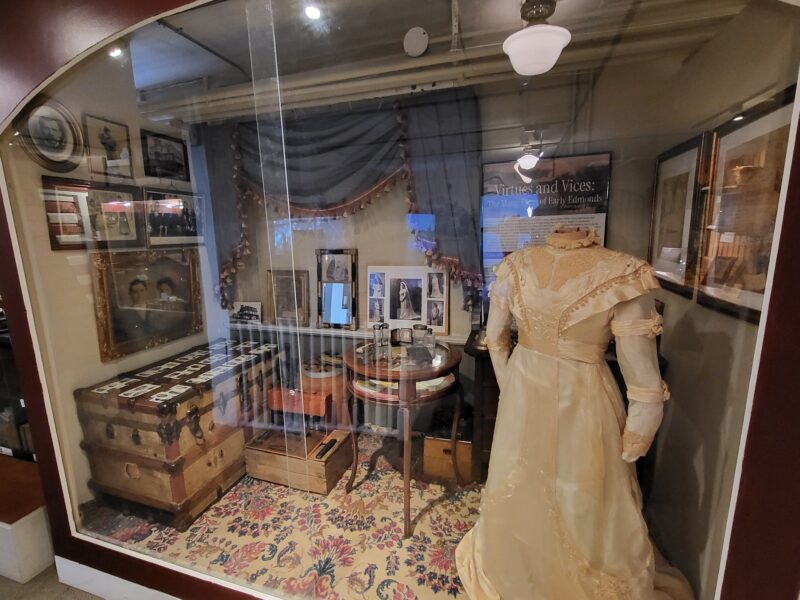
Edmonds as we know it today began in the Victorian era (1837-1901), officially becoming a town in 1890 and transitioning from a place primarily occupied by single men in the logging business to a home for families over the next few decades, carrying over past the end of Victorian times and into the 1920s. This iteration of the permanent exhibit, located in the case next to the elevator on the bottom floor, seeks to provide a window into life during this transitional period. In many ways it is a hodgepodge of objects from 1850-1924, but there are three main topics that are of particular importance: Zenna Cook, the Olympic Hotel, and the 1909 wedding dress.
Zenna Cook, daughter of 1911 Edmonds mayor W. H. Cook, must always appear prominent in this exhibit, as she donated several of her possessions to the museum on the condition that something of hers be always displayed in the downstairs case. Her silver dresser set and curio table offer a look at a refined and extravagant aspect of life in early Edmonds.
On a similar note, objects from the Olympic Hotel showcase the still refined but humbler aesthetic of people traveling to Edmonds in its early days. The ceramic washbasin allowed guests to stay clean while the wooden dresser gave them a place to store their clothes and the dinner bell let them call for their evening meals.
Returning to the fancier side of things, there is the true heart of this exhibit: the wedding dress. Made by a Portland dressmaker in 1909, it displays the level of craftsmanship common to garments made at that time and has been worn by five different women from the same family. Its most recent wearer, Meg Fuell (wife of museum board secretary Larry Fuell), has graciously shared this part of her family history by loaning the dress to the museum.