Coast Salish People
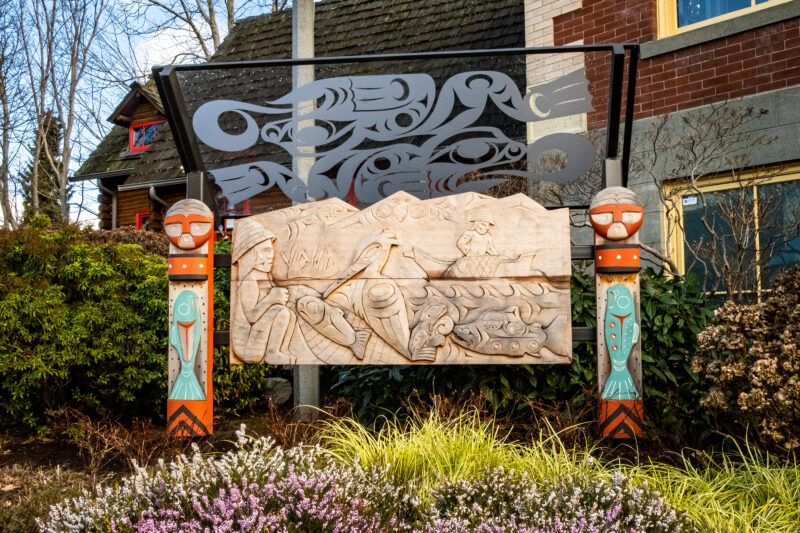
The Coast Salish people are of fundamental importance to the heritage of Edmonds. We’re celebrating that history with a cedar panel carving by Ty Juvinel (Tulalip). The carving is placed in front of the museum in our Reflection Plaza set amongst a natural setting evoking the marsh.
We are grateful to the Edmonds Arts Festival Foundation, the Hubbard Family Foundation, the City of Edmonds and private donors who made this project a possibility.

History
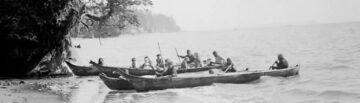
The Edmonds area was an integral part of the Coast Salish tribes’ way of life for thousands of years before the settlers arrived. The area was rich in natural resources harvested by Coast Salish tribes. The marsh provided bark and cattails, the Puget Sound provided ample fishing, and berries, roots and other resources could be found on trails stretching to Lake Ballinger.
Although there is no archaeological evidence of an established village in Edmonds, the area — especially the marsh — was an important summer destination for the Coast Salish tribes, which helped sustain them during the winter months. While they came to harvest fish, shellfish, reeds, medicinal plants and other resources, they also spent weeks sharing the marsh bounty and socializing, and held marriage ceremonies connecting different tribes. Before settlement, the marsh stretched nearly 100 acres. Continued development over the years has reduced the area to its current 22.5 acres.
‘Marsh Life’ Panel
Honoring the land and the Coast Salish tribes who came before, ‘Marsh Life’ is an artistic depiction and window into what life may have been like for Coast Salish communities living in the area. The piece demonstrates how the biodiversity and natural resources of the marsh were an important part of Coast Salish traditions and way of life.
Artist Ty Juvinel carved the mural from two 4-inch-thick planks of cedar harvested in the Puget Sound region. A Coast Salish design using positive and negative shapes, the rendering of fisherman and animals includes Coast Salish motifs and symbols handed down over centuries by carvers. The panel is carved at three different depths, using the Salish carving style that features crescents, trigons (or wedges) and ovals — three of the most prominent shapes in Coast Salish design.
Juvinel also designed the Coast Salish frog etched on the skylight shelter. WAQ’ WAQ’ (frog) is highly regarded in many native communities, and is especially revered in Coast Salish culture as a powerful spiritual figure who can move between two worlds: the spirit world and the physical world. This belief is based on the frog’s ability to live both on land and in water, and their capability to hibernate during the winter. They also play a significant role in the modern world. Frogs are “indicator species” and their presence implies that marshlands are healthy; when they begin to die or diminish in volume, it can signal an unhealthy ecosystem.
In addition, the panel includes two salmon “guardians” on either side of the carving.
“The carving is the story of how societies used to work in harmony with nature,” Juvinel said. “It’s a relationship we need to get back to.”