• Skip to main content
  • Skip to header right navigation
  • Skip to site footer

Welcome to fall! Time to get your scarecrow together!

Scarecrow Festival 2026!

Edmonds Historical Museum

Explore the Past. Empower the Future.

  • Visit
    • Visit Our Museum
    • Visit the Collections Center
    • Visit the Museum Markets
    • Shop Our Store
  • What’s Happening
    • Edmonds Historical Museum Exhibits
    • Events & Programs
    • The Collections and Research Center
      • Artifact Donation
      • This Just In! -Mar-Vel Marble Sign
      • This Just In!- A Collection of Cameras
      • This Just In!- Galloping Golf Dice Game
      • This Just In!- John Madden Football 1988
      • This Just In!- Mandolin Harp
      • This Just In!- Museum Skylight Vent
      • This Just In!- Princess Theater Movie Poster
      • This Just In!- Telegraph and Issaquah Ferry Paintings
      • This Just In!- Wooden Toy Logging Truck
      • UnVeiling the UnExhibited – Flapper Dresses
      • UnVeiling the UnExhibited- Flexible Flyer Sleds
      • UnVeiling the UnExhibited- Women’s Swimwear
    • Edmonds Fire Safety Foundation
    • Edmonds Historical Museum Farmers Markets
      • Edmonds Museum Summer Market
        • 2026 Summer Market Vendor Information
      • Edmonds Museum Holiday Market
        • 2026 Holiday Market Vendor Information
      • Edmonds Museum Winter Market
        • 2027 Winter Market Vendor Information
    • Edmonds Serves
  • Resources
    • Past Exhibits
    • Documents and Links
      • Edmonds History
    • Vintage Photographs
    • Museum and Market Art Gallery
    • CoronaCoaster Video Series
    • Honoring the Coast Salish People
    • Oral History Video Series
    • Research Request
  • Education
    • Historic Edmonds Audio Tours
    • Historic Walk
    • School Field Trips
    • Trunk Tales
  • Get Involved
    • Donate
      • Heritage Bricks Program
      • Donate for a Snohomish County Fire Service Museum
    • Become a Member
    • Become a Volunteer!
    • Business Partnerships
    • Volunteer Sign In
  • About
    • Museum & Society
    • Museum Board & Staff
    • Board Records
    • Press & Newsletter Archive
    • Grants Received
    • Contact Us

From Forest to Farmland

A Collection

Ground Level

Permanent Exhibits

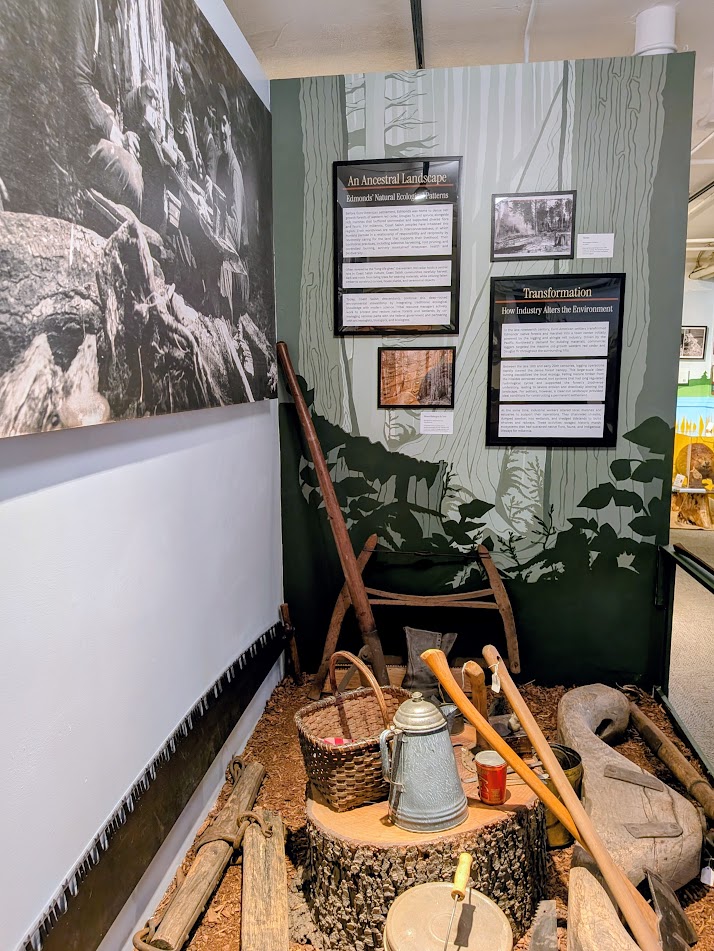
This exhibit explores how the landscape of the Edmonds area transformed from dense forests inhabited and managed by Indigenous peoples into a logging and farming community. Through artifacts and photographs, visitors will learn how natural resources fueled the growth of Edmonds while also dramatically altering the local environment.

Before Euro-American settlement, Edmonds was home to dense old-growth forests of western red cedar, Douglas fir, and spruce, alongside rich marshes that buffered stormwater and supported diverse flora and fauna. For millennia, Coast Salish peoples have inhabited this region. Their worldviews are rooted in interconnectedness, in which humans partake in a relationship of responsibility and reciprocity by reverently caring for the land that supports their livelihood. Their traditional practices, including selective harvesting, root pruning, and controlled burning, actively maintained ecosystem health and biodiversity.

While rowing along the Puget Sound in 1870, George Brackett (1841-1927) encountered brisk winds that pushed him to the shores of what is now Edmonds. There, he saw a gently sloping shoreline, convenient access to fresh water, and a forest rich in old-growth red cedar and Douglas fir. Brackett knew his search for a site fit for a logging and mill town had ended. He returned in 1876 after purchasing 140 acres of land containing a portion of the waterfront and the hillside west of its shores. By 1886, Brackett had built a small sawmill and a wharf where the ferry terminal sits today.

At the turn of the century, the growth of Edmonds’ logging and shingle mill economy enticed working men from across the country, and even the globe, to move for work in Edmonds’ mills and forests. 

Loggers worked tireless days in the woods felling red cedar to transport to the waterfront mills, where mill workers then processed the timber into shingles. Massive old-growth red cedar, which often stood up to sixteen feet in diameter and two hundred feet tall, required an extensive, multi-step process before loggers could begin to haul them to the shingle mills.

As alternative building materials gained popularity in the 1920s, national demand for hand-split wooden shingles declined. The waterfront mills gradually closed their doors over the following decades until the final mill shut down in 1951.
PXL 20260918 195752804~2 (1)

Edmonds Historical Museum

118 5th Ave N Edmonds, WA 98020

425-774-0900

Normal Hours & Admission

Friday: 1 PM – 4 PM

Saturday: 9 AM – 2 PM

Sunday: 1 PM – 4 PM

Suggested Donation to Help Grow Programming:
$5.00/adult
$10.00/family

Connect With Us

  • Contact Us
  • Terms of Use
  • Privacy Policy
Volunteer Scheduling

Sign up for the e-newsletter!

Receive early notification of exhibitions and events, first opportunity for tickets, and more!

Copyright © 2026 · Edmonds Historical Museum · All Rights Reserved · Website By Cascading Pixel