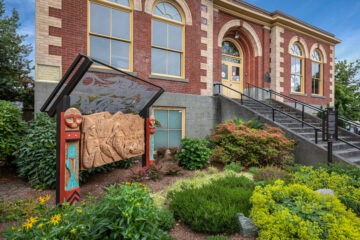

As the cold settles in Edmonds, so does the hope of children for a heavy snow fall this season. Not only does this mean school will be canceled, but also they get to play in it. Dreams of building snow forts, having snowball fights, and sledding down a hill dance in their heads. But this idea is not a novel one. These activities have been enjoyed in Edmonds for many years. In this edition of UnVeiling the UnExhibited, we’ll take a look at some sleds from our collection.
The Flexible Flyer Sled
Both sleds in our collection are Flexible Flyers. These were patented by Samuel Leeds Allen in 1889 after much prototyping with local children and adults in Cinnaminson, New Jersey. Production of these sleds began in his farming equipment factory as a way to keep his workers busy outside of farming season. However, the Flexible Flyer was not an instant success. It was rejected by retailers for years before they were marketed to toy departments in department stores. By 1915 the company was selling 2,000 sleds a week with an estimated 120,000 each winter season!
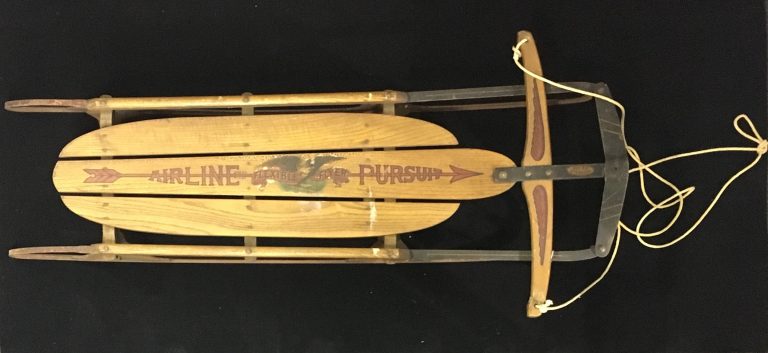
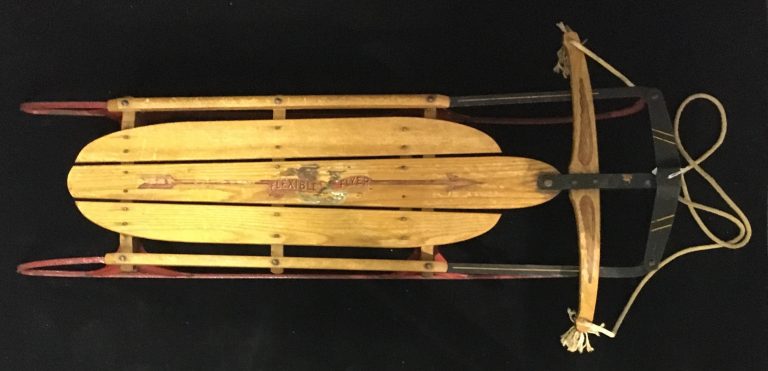
Now a household name, the Flexible Flyer was unique because of its steering ability. Up to that point, a sled rider had little control beyond traveling in a straight line – toboggans were equally likely to travel only in a straight line as well. The popularity of the Flexible Flyer brand grew steadily in the 1920s. The sled’s design was improved with changes such as steerable bumpers in 1928 and rounded rears for the runners in 1935. These rounded rears called “Safety Runners” helped prevent sledders from accidentally impaling themselves on sleds ahead of them.
The Airline Series
The sleds in the Edmonds Historical Museum’s collection are likely from this design since they possess “Safety Runners”. Each are part of the “Airline” series which started manufacturing in 1935. The model names in this series indicated the length of the sled. Models in the “Airline” series included: Ace (37), Pilot (41), Patrol (44), Pursuit (47), Junior (51), Chief (55), Racer (60), Cruiser (65), Eagle (151), and Commander (105). Between 1935 and 1949 the model name was displayed on the deck. After 1949, the series name and model were displayed on the undercarriage. Also after 1949, the numbers 37, 44, 55, and 65 were considered “Standard Models” with wider decks and straight sides. The numbers 41, 47, 60, and 251 were “Racing Models” featuring narrow, sloping and tapered decks.

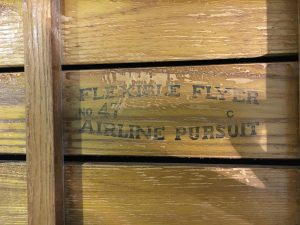
The model of these sleds, “Pursuit” indicates that they are 47” long. One has the name displayed on the deck while the other has it displayed underneath. This means one is likely from c. 1935-1949 and the other is likely from c. 1950-1954. The Airline names were eventually dropped with a number and/or letter replacing them, but with the same lengths as before, and the length being the model number. This series was ended by 1962.

 UnVeiling the UnExhibited- Women’s Swimwear
Hello Edmonds Historical Museum,
I’m reaching out to you from Kitsap County in regards to your Antique Sleds collection, specifically Flexible Flyers.
I am looking for a home for my Airline Racer stamped L, No. 60 H that I brought out here with me from New England several decades ago. It’s in pretty wonderful condition and I’m happy to send along pictures if there is interest on your end. This would be a donation to you. I am in a significant “downsizing”.
Look forward to hearing back from you. Thanks.
I have a Aero Flyer from the 1950s, but can’t find any history on it.
I have a Flexable Flyer, Airline Racer. It is a fast sled. I live in a town at 4500 ft. elevation and we have snow November through May.
I’m looking to sell it.
Do you have any idea how I should price it ???
Had a flex flyer with high rails and long sled ? Can any one find pictures of one?
As a child, we could never afford such an expensive sled. I used flattened cardboard boxes most of the time. One time some one had a real flexible flyer and I was able to get a few rides. It was stupid fast by comparison. I never forgot it. I have no idea which model it was. I guess one of the smaller ones. This was in the 60s.